Engineering Representation · Australia
On the ground for you,
from bid to handover.
€0.5B of capital delivered and de-risked across four continents.
On site for you
AvailableNicole Stenger



Read the transcript
Every problem on an overseas project is one of two kinds. The ones you can solve from a screen in Europe, and the ones that need someone standing on the site in Australia. The first, you plan for. The second, you don't see coming: a permit that won't issue, a fine that halts the job, the local crew walking off site. You hear about it on a status call you can't verify, after it's already cost you days, euros and partner trust. What is needed is expertise and judgement on the ground.
I've delivered and de-risked over half a billion euros of capital across four continents, without missing a deadline, and overseen region-specific risk across launches in eleven countries. Short of holograms becoming the norm on site, a month of status calls can't do what one conversation with an empowered person in the room can. On the ground, risks get intercepted before they turn into issues.
In the next few minutes I'll show you why these delays keep happening, and the one thing you need in place to catch them before they cost you: flexible to whatever the project throws up, for less than the trips it replaces.
Right now you have three ways to stay on top of a project on the other side of the world, and each one has a failure point.
You fly someone out. Sixteen thousand kilometres each way, two days gone to travel, and with the jetlag they arrive at half capacity and lose more time recovering on the way back. You've pulled a senior person off everything else for the best part of a fortnight. And the problem doesn't leave when they do. They fly home, you're blind again, and the next time an inspection fails or a supplier isn't what they claimed, you pay for the whole trip a second time.
You hire locally, early. Now you're three months into recruitment, carrying a salary of a hundred and fifty thousand euros before on-costs, for a role you had to define before you knew what the project would actually need.
Or you run it on reports. The timezone gives you an hour or two of overlap, at the wrong end of someone's day, so information reaches you late, and as someone else's account of what happened, you can't check. More reporting doesn't fix that. It tells you about the delay later, in more detail.
I was launching Amazon fulfilment sites in Germany at the peak of the pandemic demand surge, where a single launch day lost ran into the millions.
So before we go further, work it out. What does one lost day cost you? Take one example: a commissioning team of five, flown in, standing on a site that isn't ready. A day of them idle runs quickly into five figures on day rates alone, before the specialist equipment beside them, before the tasks downstream that can't start, before the days that slide off the end. Keep the figure in mind.
You get access to senior judgement, without a long onboarding or a long-term commitment. I personally deployed three sites in three years, each over half a million square feet, twenty kilometres of conveyance, no room for negotiation on the launch date or quality, and without once dipping into contingency budget.
Six technologies served across my career. Client-side, client-facing. Small, medium, large. Paint engineering. Dimensional build integrity. Robotics fulfilment. Infrastructure. Packaging. Signage. I didn't start out as the expert in the technology on any of them, and I never missed a deadline.
The common denominator across every site, every product launch, every deadline taken over the line against the odds, was my judgement, day by day, on where to hyperfocus, which risk to zoom in on, who to nudge, not by asserting dominance, but steering when needed, mobilising specialists. That's how you hold a scope that size without going insane, and it only works if you're trusted to make the call on the spot. Phoning it home and waiting is hard enough anywhere, and near impossible when your only overlap with the office is a two-hour window at the end of the day.
Instant Presence began with my own arrival in Australia. And it began with a failure.
I came here with a First Class engineering master's degree, Amazon and JLR behind me, references that opened doors anywhere else in the world. And I couldn't get hired. Whole categories of work were closed to me in Canberra, where everything is federal-adjacent, on eligibility and clearance, even at private firms, regardless of what I'd done. Where I was eligible, none of it counted the way local experience did. Here it comes down to who you know, and I knew no one.
I was dealing with rejection, after I'd thought I'd future-proofed my career with years of intense overcompensation at work. In my final year at Amazon I led the cluster for region-specific risk. Eleven specialists under me, one for each country: same design, same intent, same team, same milestones, same vendors, same SOPs, even the same PMs, and a country's own nuance would still throw up a failure nobody had planned for. Which was exactly what I did, arriving in Canberra blind. I hadn't checked, because you can't check for what you don't know is there.
I learned from it. I went back to something I discovered thirteen years ago at JLR, feeling intimidated at first as the only woman in a room of men deciding the structural joins on a car body shell: you build trust one relationship at a time, face to face. That's my approach here today, because in Australia relationships and networking are beyond valuable. Being in the room counts.
I learned how things work here, and built Instant Presence to hybrid my EU and AU knowledge. Physically here, but working to your standards: communication, deadlines, professionalism.
So how does this help you? What happened to me is what happens to a project.
My final year at Amazon included ownership of the region-specific risk across every MHE site in the region, which gave me a view across all of them. And even with the same standard design, the same SOPs, the same team on every one, each site still got caught by something local no one saw coming.
In Poland, the pre-launch commissioning wasn't allowed until the building itself was permitted to open. In the Czech Republic, the local noise regulations meant our standard insulation design was insufficient. In Turkey, the drain connection sat outside the standard regional scope, so it was never installed, and the building flooded. In the UK, local electricians formed a picket line over a safety concern that proved unfounded, and it still stopped the site. A new failure each time, none of them pre-conceived in the risk register.
In Europe, these were a neighbouring country away, so we could contain them. From sixteen thousand kilometres, you can't. Even if you drop everything and fly the moment it happens, that's thirty-six hours in the air with the meter running at the lost-day cost you worked out earlier, and the problem was already moving before you booked the flight. Without someone there, you're out of control.
Instant Presence becomes your conduit. In: your standards, your SOPs, the project context and requirements. From my side: the local network, the access, and the experience of getting things built here. Your standards applied on site. Actual status in your inbox.
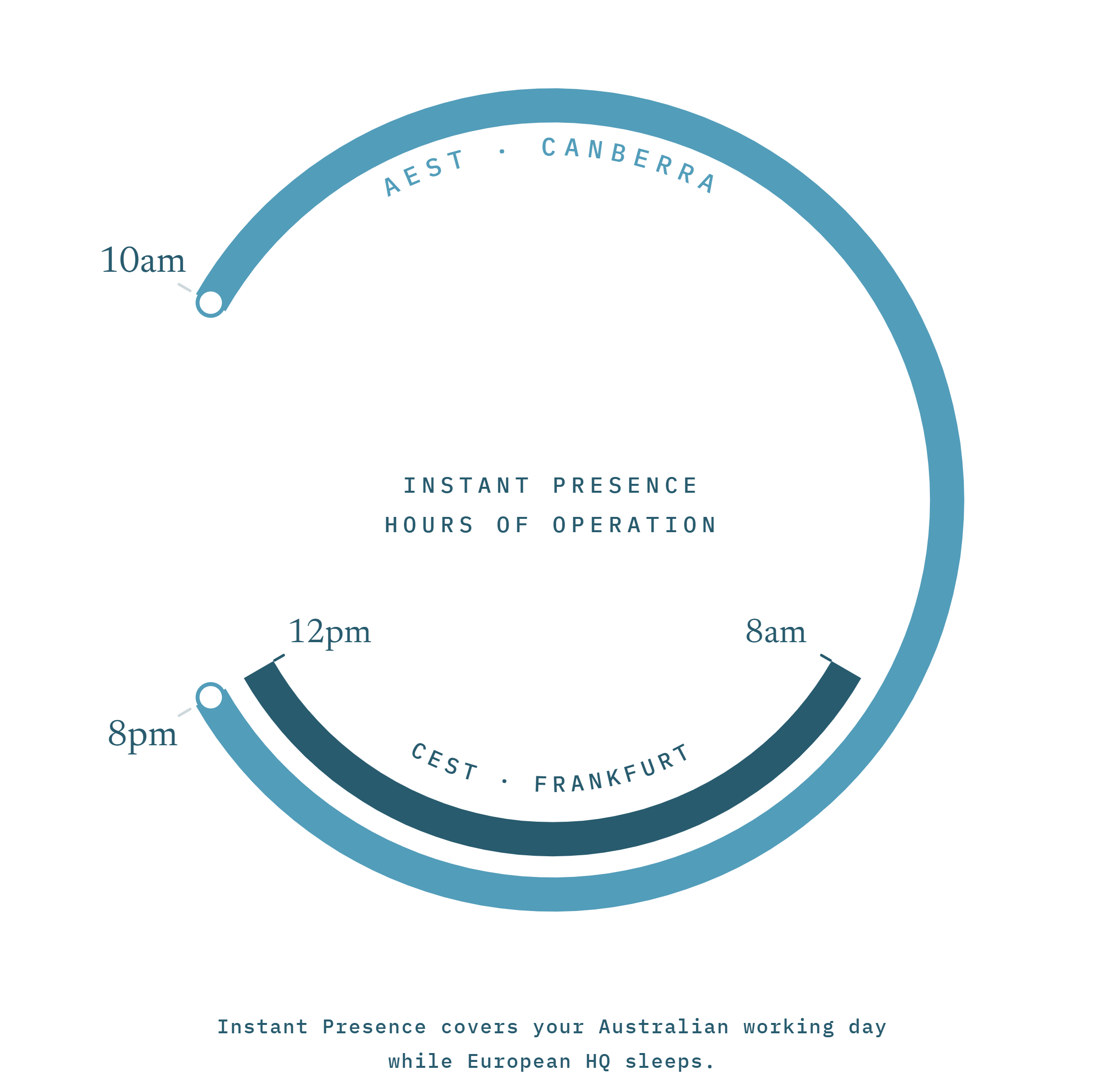
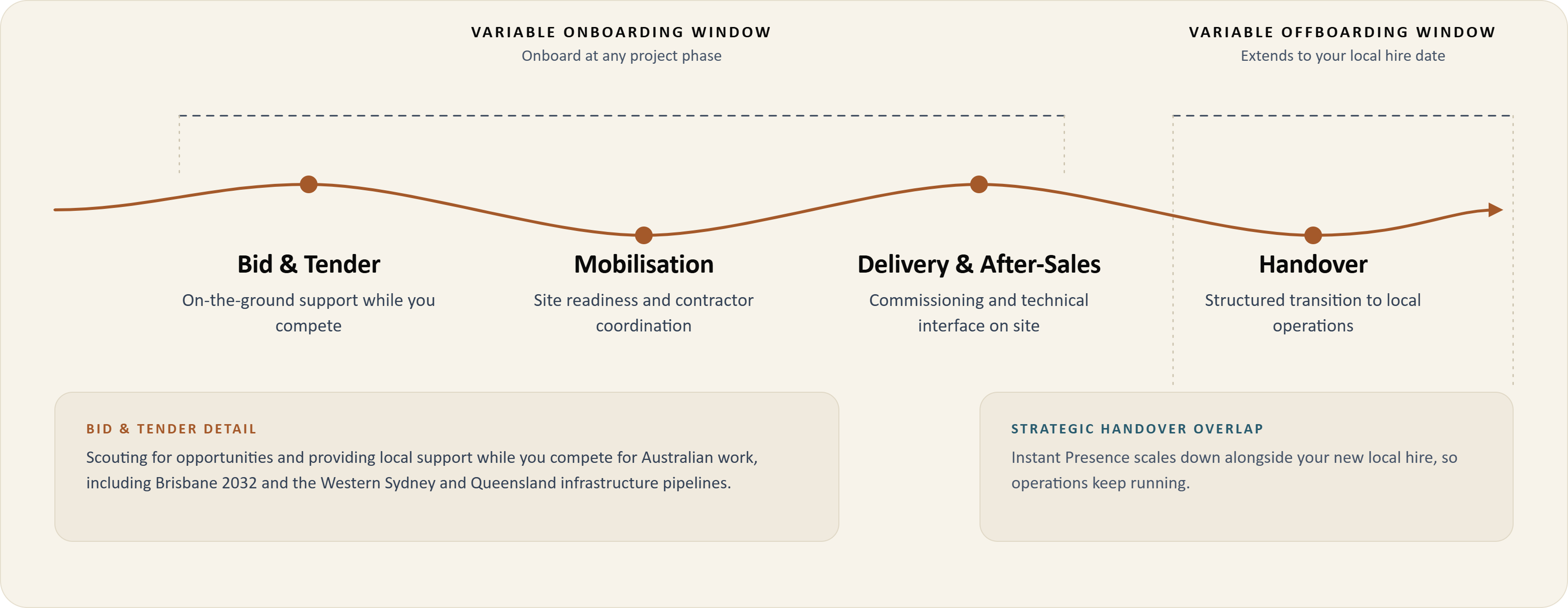
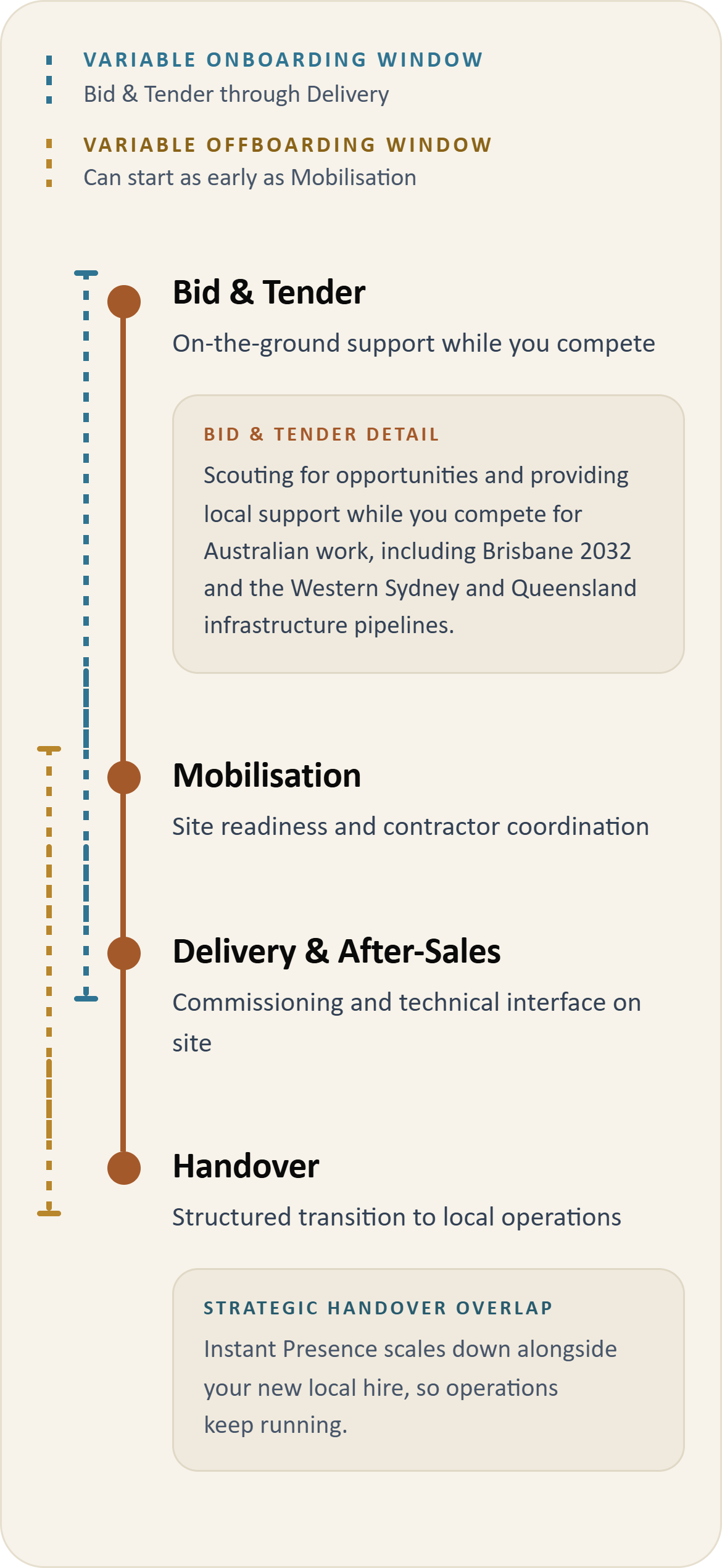
In practice, representation means whatever the phase in front of you needs. Vetting and meeting suppliers face to face before you commit. Chasing permits and holding the site to local regulation. Taking the calls and site meetings in Australian hours, so your team isn't dialling in at 6am. Getting the site ready before your team flies out. Writing the RFQs for smaller equipment to Australian standards. The specific things that go wrong from a distance, handled by someone standing there.
I report progress, resource, and what's slipping and why, and hone in on the technical specs where required. My reporting is built to hold across opposite ends of the culture spectrum, from a factory floor in China to a European boardroom. I learned that early, remotely supporting new JLR model launches at our sister factory in China, where a nod in the room didn't always mean alignment. Visuals and removing ambiguity works.
You bring Instant Presence on when you need presence, and stand it down when you don't. Scale up for a critical phase, scale back after. A project here doesn't mean opening an office or becoming a multi-continent employer. No permanent headcount, no long contract: you run the service as long as you need it, then it's wrapped. And you get senior, cross-industry range, not a specialist locked to one task, on site in less time than it takes to book the flights.
I owned an infrastructure change at Amazon that won VP approval, aligned more than twenty stakeholder teams, and spanned four continents on its own. Zero safety incidents across live, multi-contractor commissioning floors. Number one build quality in its class. When I was client-facing here in Australia, delivering signage for the Australian Open and Westfield, I won fifty percent more scope, because the Australian Open runs on fast turnaround. I'm here in the market full time, not flying in.
Who this is for: European engineering and industrial SMEs with a live or committed project in Australia, who need it done properly and value a trusted partner.
If you're a firm with a hundred million to put into a first office here, a five-year lease, a tax presence, permanent salaries, you don't need me, and you don't have these problems. Instant Presence is for the firms who won't carry that cost to run a single project. You get the presence, without the office, the relocation, or the payroll. It isn't the cheapest set of eyes with a camera either.
If you're asking whether I really know this market when I'm not Australian, why you'd trust someone you haven't met, or what the return is, here's my answer.
I've worked here, I live here, and I built my network the way anyone does, in person, over time.
Everything Instant Presence reports is what was seen in person, the next day, with the evidence.
One wasted mobilisation, or a handover that slips by weeks, can easily cost more than a full year of this service. Put that against the lost-day figure you worked out earlier.
You don't know my technology. Correct. A secret of mine: I was never the specialist in the technologies I worked in before, and I never missed a deadline, because project success depends on program overview.
If this service could be right for your business right now, book a call using the link below. I'll go through your Australian project with you, where it is, what's coming, and where the risk lies, and together we'll work out what the right move is.
Before you do, the options. A local hire is a hundred and fifty thousand euros in salary alone, before on-costs, three months to find, and a permanent commitment for a project that isn't permanent. Flying people out is a senior person gone for the best part of a fortnight each time, and blind in between. Instant Presence costs less than flying them out, and unlike a hire, there's zero commitment: scale it up, scale it down, wrap it when the project's done. Set any of it against the lost-day figure you worked out earlier.
If you're not sure, don't commit to anything big. Put Instant Presence to work for a single meeting, or one site visit, and judge the result. Book the call. Fly without flying.
The Offer
Small engagements are welcome too. A few hours on the ground may save you the international trip.